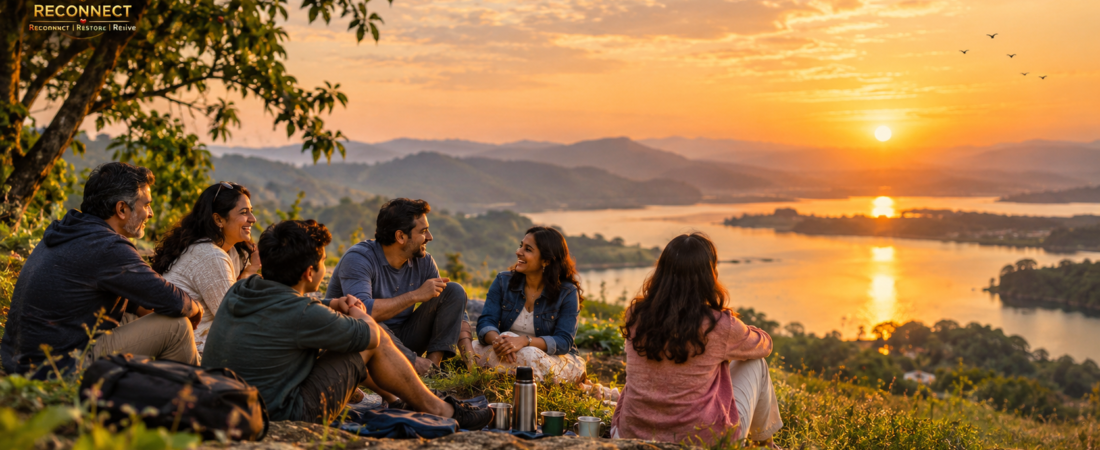
You don’t always need a vacation to feel alive. Sometimes, you simply need to pause long enough to notice the life you already have.
By Alban Horne | REconnect
There is a strange contradiction in modern life.
We work hard because we want a better life.
We earn because we want security.
We achieve because we want progress.
We plan because we want a better future.
And yet, somewhere between working for tomorrow and worrying about yesterday, we often forget to actually live today.
We tell ourselves:
“I’ll relax after this project.”
“I’ll spend more time with my family once things settle down.”
“I’ll take a holiday when I have more money.”
“I’ll enjoy life once I achieve my next goal.”
“I’ll start taking care of myself when I have more time.”
But life rarely becomes completely free of responsibilities.
There will always be another deadline, another bill, another target, another problem, another responsibility and another reason to postpone joy.
That is why taking a break is not a luxury. It is part of living a balanced life.
A break does not always mean an expensive holiday or a weekend at a resort.
Sometimes a break means sitting with your family without checking your phone.
Sometimes it means meeting an old friend over a cup of tea.
Sometimes it means walking through a park.
Sometimes it means watching the sunrise in silence.
Sometimes it means standing on your balcony and watching the sunset.
Sometimes it means laughing with people you love for no particular reason.
And sometimes, it simply means sitting quietly and appreciating how far you have come.
The Importance of Taking a Break in a Busy Life
Many people have learned how to work hard but have forgotten how to stop.
We often treat rest as something we have to earn.
We finish the work and then rest.
We complete the target and then celebrate.
We solve the problem and then breathe.
But there is always another task waiting.
Research and guidance from the American Psychological Association emphasize that meaningful breaks and psychological detachment from work can support recovery, energy and well-being. Breaks can also help people return to demanding activities with renewed attention and energy.
The problem is not that we are busy.
The problem is when being busy becomes our entire identity.
When every moment has to be productive, even a beautiful sunset can begin to feel like wasted time.
That is when we need to remind ourselves:
Not everything valuable has to produce something.
A conversation can be valuable.
A walk can be valuable.
A family dinner can be valuable.
Watching clouds move across the sky can be valuable.
Doing absolutely nothing for a few minutes can be valuable.
Life is not only about what you accomplish.
It is also about what you experience.
Taking a Break Does Not Mean Giving Up
There is an important difference between resting and quitting.
Taking a break does not mean that you have lost ambition.
It does not mean that you are lazy.
It does not mean that your goals are no longer important.
It means that you understand that you are more than your goals.
Imagine driving a car continuously without stopping.
Eventually, the engine needs attention.
The tyres need checking.
The fuel needs replenishing.
The vehicle needs maintenance.
Your mind and body are not fundamentally different.
You cannot continuously demand energy from yourself without replenishing it.
A meaningful break gives you an opportunity to step away from the constant pressure of doing and return to the simple experience of being.
Why Small Moments Matter More Than We Realize
We often imagine happiness as a major event.
A promotion.
A new house.
A new car.
A foreign holiday.
A wedding.
A financial milestone.
A successful business.
A major achievement.
These moments are wonderful.
But if happiness depends only on major achievements, we may spend most of our lives waiting.
The truth is that much of life happens between the big moments.
It happens during ordinary mornings.
It happens over family meals.
It happens while travelling with friends.
It happens when someone calls just to ask, “How are you?”
It happens when your child tells you something unexpectedly funny.
It happens when an old friend remembers something you had forgotten.
It happens when you drink your morning tea while watching the sky change colour.
It happens when you sit beside someone you love without needing to say anything.
These moments may not look significant on a calendar.
But they often become the memories we carry for years.
Spend Time With Family Without an Agenda
One of the greatest gifts you can give your family is not money.
It is attention.
Being physically present is not necessarily the same as being emotionally present.
You can sit in the same room while everyone is looking at separate screens.
You can eat dinner together while answering work messages.
You can go on holiday while spending half the trip taking photographs for social media.
You can be surrounded by people and still be somewhere else mentally.
Taking a genuine break creates an opportunity to reconnect.
Try having a meal without phones.
Go for a walk together.
Cook something as a family.
Play a board game.
Visit relatives.
Sit on a balcony and talk.
Drive somewhere without turning the journey into another task.
Ask your children about their lives without immediately correcting them.
Ask your partner how they are feeling without turning the conversation into problem-solving.
Call your parents.
Meet a friend you haven’t seen for months.
The objective is not to organise a spectacular experience.
The objective is to share an ordinary experience fully.
Strong social connections are associated with better health and well-being, and the CDC specifically encourages people to spend quality time with family and friends and to build meaningful social connections.
That is an important reminder in a world where digital communication can create the illusion of connection without always providing the depth of human presence.
Go Back to Nature
You do not have to travel to a remote mountain or forest to experience nature.
Nature can be remarkably close.
A garden.
A park.
A lake.
A tree-lined road.
A balcony filled with plants.
A patch of grass.
A morning sky.
The sound of birds.
The smell of rain.
The movement of clouds.
The changing colours of the evening sky.
These simple experiences can interrupt the mental noise of everyday life.
The World Health Organization notes that natural environments can support physical and mental well-being, including through opportunities for relaxation, physical activity and social interaction.
Nature does something else that is equally important.
It reminds us that not everything operates at our speed.
Trees do not rush.
Clouds do not compete.
Rivers do not worry about productivity.
The sunrise does not ask whether yesterday was successful.
The sunset does not care whether you completed your to-do list.
Nature simply exists.
And sometimes we need to do the same.
Watch the Sunrise Once in a While
There is something powerful about waking up early enough to watch a new day arrive.
You don’t need a motivational speech.
You don’t need music.
You don’t need a productivity app.
Just sit somewhere comfortably.
Watch the darkness gradually become light.
Notice the changing colours.
Listen to the sounds around you.
Take a few slow breaths.
Let your mind be quiet for a few minutes.
A sunrise can become a personal reminder:
You have another day.
Whatever happened yesterday has already happened.
Whatever tomorrow brings has not happened yet.
But this moment is here.
And you are here to experience it.
The value of watching a sunrise is not that it magically solves your problems.
It doesn’t.
Its value is that it gives you a small period in which you are not trying to solve everything.
You are simply observing life.
And Don’t Forget the Sunset
We often celebrate beginnings but forget to appreciate endings.
A sunset can teach us something beautiful about completion.
The day does not need to continue forever to have been worthwhile.
It can end.
And tomorrow can begin again.
Perhaps that is a lesson many of us need.
You do not have to finish everything today.
You do not have to solve every problem tonight.
You do not have to prove your worth every day.
Some days are productive.
Some days are difficult.
Some days are joyful.
Some days are disappointing.
And some days are simply ordinary.
They are all part of your life.
So occasionally, stop.
Look at the sunset.
Take a breath.
And tell yourself:
“I made it through another day.”
That is worth appreciating too.
Take a Break From Your Phone, Not Just From Work
Sometimes we think we are taking a break when we are actually switching stimulation.
We stop working and start scrolling.
We leave the office and open social media.
We sit with family while checking messages.
We go on holiday but remain connected to email.
Our body may have stopped working, but our mind has not stopped consuming information.
A genuine break sometimes requires digital distance.
Try putting your phone away for 30 minutes.
Go for a walk without headphones.
Have a meal without screens.
Sit outside without photographing everything.
Talk to someone without checking notifications.
Watch the sunrise without immediately posting it.
Watch the sunset without trying to capture the perfect photograph.
Sometimes the memory belongs to you.
It does not need to belong to the internet.
Take Breaks Before You Need Them
One of the biggest mistakes people make is waiting until they are completely exhausted before resting.
We often recognise burnout only after we have reached the edge.
But rest works better when it becomes part of the rhythm of life rather than an emergency response.
Think about exercise.
You don’t exercise only after your body becomes unhealthy.
You exercise to maintain health.
The same principle can apply to emotional and mental well-being.
You don’t need to wait until you are overwhelmed before taking a walk.
You don’t need to wait until your marriage feels distant before spending meaningful time together.
You don’t need to wait until your children grow up before creating family memories.
You don’t need to wait until retirement before enjoying your life.
You don’t need to wait for a crisis before reconnecting with yourself.
Take the break while life is still manageable.
The REconnect Approach: Stop, Notice, Connect
At REconnect, the idea of personal growth is not only about becoming more productive.
It is also about becoming more aware.
More connected.
More present.
More human.
Taking a break can become a simple REconnect practice.
REconnect with Yourself
Ask:
- How am I actually feeling?
- What has been consuming my mental energy?
- When was the last time I did something simply because I enjoyed it?
- Am I living or merely completing tasks?
REconnect with Relationships
Ask:
- Who do I genuinely enjoy spending time with?
- When was the last time I had an uninterrupted conversation with someone I love?
- Have I been physically present but emotionally unavailable?
- Is there someone I should call today?
REconnect with Nature
Ask:
- When did I last watch a sunrise?
- When did I last sit outside without my phone?
- When did I last walk simply for the pleasure of walking?
- When did I last notice the sky?
REconnect with Life
Ask yourself:
“If nothing major happened today, could I still appreciate today?”
That question can change the way you experience ordinary life.
You Don’t Need More Things. You May Need More Moments.
Modern culture constantly tells us that the next thing will make us happier.
The next purchase.
The next destination.
The next promotion.
The next achievement.
The next milestone.
But sometimes what we actually need is not another thing.
We need another moment of connection.
A long conversation.
A shared meal.
A walk.
A laugh.
A hug.
A quiet morning.
A beautiful sunset.
A weekend with friends.
A few minutes alone.
A genuine conversation with our partner.
A game with our children.
A cup of tea with our parents.
These things are easy to overlook precisely because they are simple.
But simplicity does not mean insignificance.
Create Your Own “Small Joy” Ritual
You don’t have to completely change your lifestyle.
Start small.
Create one ritual that belongs to you.
The 10-Minute Pause
Take ten minutes every day with no work and no social media.
Sit quietly.
Breathe.
Look outside.
Let your mind settle.
The Weekly Family Hour
Choose one hour every week when everyone puts away their devices and simply spends time together.
The Sunset Ritual
Once a week, deliberately watch the sunset.
Don’t multitask.
Just watch.
The Nature Walk
Take a 20–30 minute walk in a park or natural environment.
Walk without rushing.
The Friendship Call
Call one person every week whom you genuinely care about.
Not because you need something.
Simply because you want to connect.
The Gratitude Moment
Before going to bed, identify three ordinary things from the day that were worth appreciating.
They don’t need to be impressive.
They simply need to be real.
A Break Can Change the Way You See Your Life
Sometimes the problem is not that our life has become empty.
It is that we have become too busy to notice what is already there.
Taking a break creates distance.
And distance creates perspective.
When you step away from your routine, even briefly, you may notice things you have been ignoring.
You may realise that your child is growing faster than you thought.
You may realise that your partner has been asking for your attention in subtle ways.
You may realise that an old friendship deserves another conversation.
You may realise that your body is tired.
You may realise that your mind needs silence.
You may realise that your goals are still important—but they don’t have to consume your entire existence.
And perhaps most importantly, you may realise:
You have already experienced moments worth being grateful for.
Don’t Postpone Your Life Until Everything Is Perfect
There will never be a perfect time to live.
There will always be responsibilities.
There will always be uncertainty.
There will always be something that needs fixing.
But there will also always be a sunrise.
A sunset.
A conversation.
A cup of tea.
A laugh.
A walk.
A friend.
A family member.
A tree.
A quiet morning.
A beautiful sky.
A moment that asks nothing from you except that you notice it.
So take the break.
Step outside.
Call someone you love.
Sit with your family.
Meet a friend.
Watch the sunrise.
Watch the sunset.
Walk through nature.
Put your phone away.
Laugh without a reason.
Celebrate something small.
And for a few minutes, stop asking:
“What do I need to accomplish?”
Instead ask:
“What can I appreciate right now?”
Because life is not only the collection of goals you achieve.
Life is also the collection of moments you were present enough to experience.
And sometimes, the most important thing you can do for your future is to stop for a moment and actually live your present.
Final REconnect Thought
You don’t have to escape your life to enjoy it.
Sometimes you simply need to slow down enough to see it.
Your family is not waiting for a perfect weekend.
Your friends are not waiting for an expensive holiday.
Nature is not waiting for you to buy a ticket.
The sunrise does not require a reservation.
The sunset does not require an achievement.
And happiness does not always arrive with a major announcement.
Sometimes it is already sitting quietly beside you.
Pause. Notice. Appreciate. Connect.
REconnect with yourself.
REconnect with your relationships.
REconnect with nature.
REconnect with life.
Because the life you keep waiting to enjoy may already be happening.
Frequently Asked Questions
1. Why is taking a break important?
Taking regular breaks can help reduce accumulated mental fatigue, support recovery from stress and create space for activities that restore energy and well-being. A break can be short and simple; it does not always require a holiday.
2. How can spending time in nature improve well-being?
Natural environments can provide opportunities for relaxation, physical activity and social interaction. Research and public-health guidance associate exposure to nature with benefits such as improved mood, reduced stress and greater well-being.
3. Why is spending time with family and friends important?
Meaningful social relationships can provide emotional support, belonging and resilience. Strong social connections are associated with better physical and mental health and overall well-being.
4. Is watching the sunrise good for mental health?
Watching a sunrise is not a medical treatment, but it can be a simple mindfulness and reflection ritual. The quiet environment, exposure to nature and opportunity to pause can help create a sense of presence and perspective.
5. Why should we watch the sunset?
A sunset provides a natural opportunity to slow down and reflect on the day. It can become a personal ritual for gratitude, acceptance and emotional transition from the demands of the day toward rest.
6. How often should I take a break?
There is no single schedule that works for everyone. Short breaks during demanding periods, meaningful time away from work and regular leisure activities can all contribute to recovery. The important thing is not to wait until exhaustion forces you to stop.
7. How can I enjoy life more without spending a lot of money?
Start with simple experiences: walking in a park, watching sunrise or sunset, cooking with family, calling a friend, having tea together, gardening, reading, listening to music or simply sitting quietly outdoors.
8. What is the difference between resting and wasting time?
Rest becomes valuable when it helps you recover, reconnect and experience life rather than constantly demanding productivity from yourself. Not every valuable activity needs to produce a measurable result.
Conclusion
Taking a break is not stepping away from life. It is stepping back into it.
When you make room for family, friendship, nature, silence, laughter, sunrise, sunset and ordinary moments, you create space for something that achievement alone cannot provide:
a life that you actually experience while you are building it.
External research and further reading
The article’s key factual points are supported by established public-health and psychology sources:
- CDC — Social Connection: explains how supportive relationships are associated with health, well-being, stress management and healthier lives.
CDC: Social Connection - WHO — Nature and health: discusses links between natural environments, mental well-being, physical activity, relaxation and social interaction.
WHO: Improving health and well-being through nature - APA — Stress management: recommends activities such as spending time in nature and maintaining pleasurable activities during stressful periods.
American Psychological Association: Healthy ways to handle life’s stressors - APA — The value of rest: discusses mental, emotional, creative and other forms of rest, including spending time outdoors and connecting with loved ones.
American Psychological Association: Seven types of rest - APA — Taking meaningful breaks: reviews evidence that regular detachment from work can help restore energy and support well-being.
American Psychological Association: Give Me a Break
Connect with us to REconnect
WhatsApp: +91 84848 18476
Email: alban.joseph@gmail.com
Website: https://reconect.in