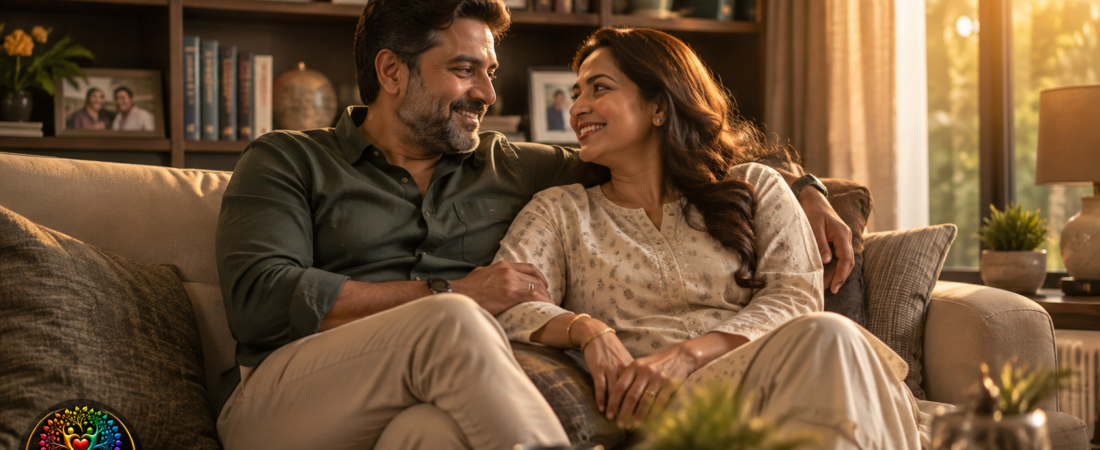
10 Signs Your Marriage Is Healthy, Even After the Excitement of the Early Years Has Faded
By Alban Horne | REconnect
There is a question that many married couples eventually ask themselves:
“Are we still in love, or have we simply become used to each other?”
It is an uncomfortable question.
Especially after 10, 15, 20 or 30 years of marriage.
The butterflies may not be the same.
The long conversations may have become shorter.
The spontaneous dates may have been replaced by grocery shopping, school runs, work deadlines and family responsibilities.
You may know exactly what your partner is going to order at a restaurant.
You may know how they take their tea or coffee.
You may know what irritates them, what time they normally sleep and which side of the bed they prefer.
But there is a deeper question worth asking:
Do you still know the person they are becoming?
Because a long marriage isn’t necessarily supposed to feel like the first six months.
The goal isn’t to preserve the honeymoon forever.
The goal is to build something deeper than the honeymoon—a relationship that can survive ordinary life, difficult seasons, changing priorities, ageing, parenting, financial pressure, disappointment and personal growth.
Research on long-term marriages has found that relationship quality is connected with patterns of interaction, emotional behaviour, communication and satisfaction—not simply the absence of disagreement. Studies of long-term couples have also found that older marriages can have meaningful sources of pleasure and less conflict than middle-aged marriages.
So perhaps the better question isn’t:
“Do we still feel exactly like we did when we first met?”
It is:
“Have we built a kind of love that can continue to grow as we change?”
That is what a happy marriage looks like.
Love Changes. That Doesn’t Mean It Disappears.
Early love often contains excitement, discovery and anticipation.
You want to know everything about the other person.
You notice their messages.
You look forward to seeing them.
You remember small details.
You make time even when you are busy.
Then life happens.
Marriage becomes real.
There are bills.
Careers.
Children.
Parents.
Household responsibilities.
Illness.
Financial decisions.
Career changes.
Personal disappointments.
There are mornings when one person is exhausted.
There are evenings when neither person has much energy left.
And somewhere along the way, the relationship can become less about romance and more about partnership.
That isn’t necessarily a problem.
In fact, it can be a sign of maturity.
A healthy marriage doesn’t need constant excitement.
It needs connection.
It needs friendship.
It needs emotional safety.
It needs respect.
It needs affection.
It needs the ability to repair after conflict.
It needs two people who continue choosing each other even when life isn’t particularly romantic.
Research from John Gottman and colleagues has repeatedly examined how patterns of interaction relate to marital satisfaction and stability. Their work emphasises friendship, positive interaction, responsiveness and the ability to repair after conflict as important relationship processes.
“The goal of a long marriage isn’t to keep the honeymoon alive. It’s to build a love that can survive real life.”
10 Signs You Are Still Building a Happy Marriage
1. You Are Still Curious About Each Other
One of the biggest differences between a relationship that continues to grow and one that becomes emotionally stagnant is curiosity.
At the beginning, curiosity happens naturally.
You ask:
“What do you like?”
“What are your dreams?”
“What scares you?”
“What makes you happy?”
“Where do you want to go?”
But years later, we sometimes stop asking because we assume we already know.
That assumption can be dangerous.
Your partner has changed since you met.
So have you.
Their priorities may have changed.
Their fears may have changed.
Their dreams may have changed.
The things they need from you may have changed.
This is why a healthy long-term marriage doesn’t simply know its partner.
It continues discovering its partner.
The Gottman Institute describes this as developing and updating “Love Maps”—knowing the inner world of your partner and keeping that knowledge current as life changes.
Try asking your partner:
“What is something you are thinking about these days that we haven’t talked about?”
Or:
“What is something you want to experience in the next five years?”
Or even:
“What has changed about you recently that you think I may not have noticed?”
These questions can open doors that routine quietly closed.
“Familiarity should make you more curious about your partner, not less.”
2. You Still Like Each Other
We talk about loving our partners.
But there is another question that is just as important:
Do you still like them?
Can you enjoy sitting together without needing entertainment?
Can you laugh about something silly?
Can you have a conversation that has nothing to do with money, children or responsibilities?
Do you genuinely enjoy their company?
Friendship is an important foundation of a healthy relationship. The Gottman Institute’s research overview emphasises the role of friendship, fondness and admiration in relationship stability and satisfaction.
A marriage can survive difficult seasons more effectively when goodwill remains beneath the problems.
That doesn’t mean you will like everything your partner does.
You won’t.
Nobody does.
It means that beneath the frustration, there remains a fundamental feeling of:
“This is my person, and I enjoy having them in my life.”
Ask yourself:
When was the last time we simply had fun together?
Not because it was Valentine’s Day.
Not because you were on holiday.
Not because someone planned a special evening.
Just because you were together.
3. You Still Notice the Small Things
Grand romantic gestures are wonderful.
But long marriages are usually built through ordinary moments.
A cup of tea.
A message during a difficult day.
A hand on the shoulder.
A genuine thank-you.
Remembering something important.
Asking:
“How did that meeting go?”
Noticing that your partner looks tired.
Offering help without being asked.
These moments may seem insignificant.
They aren’t.
Gottman describes everyday “bids” for connection—small attempts people make to receive attention, affection or engagement—and emphasizes the importance of responding to those bids.
A bid might sound like:
“Look at this.”
“You won’t believe what happened today.”
“I’m exhausted.”
“Do you remember that restaurant we went to?”
“I’m worried about tomorrow.”
These aren’t always requests for solutions.
Sometimes they are simply invitations:
“Come into my world for a moment.”
A happy marriage learns to notice those invitations.
“The strongest marriages are often built in moments that look too small to matter.”
4. You Can Disagree Without Destroying Each Other
A happy marriage is not a marriage without arguments.
That is unrealistic.
Two people with different personalities, backgrounds, expectations and experiences will disagree.
Research on marital interaction has found that disagreement itself isn’t necessarily what predicts deterioration; patterns such as defensiveness, stubbornness and withdrawal were associated with worsening marital satisfaction over time.
The important question is therefore not:
“Do we argue?”
It is:
“What happens when we argue?”
Can you disagree without insulting each other?
Can you express anger without contempt?
Can you take a break without using silence as punishment?
Can you come back to the conversation?
Can you say:
“I was wrong.”
Can you hear:
“That hurt me.”
without immediately responding:
“Well, you hurt me too.”
Healthy couples don’t necessarily avoid conflict.
They learn how to manage conflict without turning their partner into an enemy.
5. You Know How to Repair
This may be one of the most important signs of a long-lasting marriage.
Because mistakes are inevitable.
You will hurt each other.
You will misunderstand each other.
You will say the wrong thing.
You will have bad days.
You will sometimes react badly.
The difference is what happens afterward.
Do you repair?
A repair can be as simple as:
“I’m sorry.”
“I didn’t handle that well.”
“Can we start that conversation again?”
“I understand why that hurt you.”
“I don’t agree with everything you’re saying, but I want to understand.”
Research from the Gottman tradition places considerable importance on repair attempts—the words or actions that help reduce negativity and prevent conflict from escalating.
A repair doesn’t erase what happened.
It tells your partner:
“Our relationship is more important to me than winning this argument.”
“A strong marriage isn’t one where nobody gets hurt. It is one where people know how to find their way back.”
6. You Still Appreciate Each Other
Appreciation is easy to lose inside familiarity.
You may stop noticing what your partner does because it has become normal.
They make dinner.
They manage appointments.
They work long hours.
They care for the children.
They support your career.
They remember birthdays.
They handle things you don’t even think about.
And because they have always done it, you stop saying:
“Thank you.”
This is how ordinary contributions become invisible.
The Gottman Institute identifies fondness and admiration as important components of lasting romantic relationships and recommends actively expressing appreciation rather than simply assuming your partner knows it is there.
Try this tonight:
Don’t say:
“Thanks for everything.”
Be specific.
“Thank you for making sure the children were ready this morning. I know you were tired.”
Or:
“I appreciate how you supported me when work was difficult.”
Or simply:
“I don’t say this enough, but I really appreciate having you in my life.”
Specific appreciation is powerful because it tells someone:
I see what you do.
7. You Feel Safe Being Vulnerable
A happy marriage isn’t simply a place where you can celebrate.
It is also a place where you can struggle.
Can you say:
“I’m scared.”
“I don’t know what I’m doing.”
“I feel like I’m failing.”
“I’m not happy with myself right now.”
“I need you.”
without worrying that your vulnerability will later be used against you?
Emotional safety doesn’t mean your partner always agrees with you.
It means you can be honest without expecting humiliation, contempt or immediate dismissal.
Research on relationship skills has found that emotional closeness, support, communication and conflict management are associated with marital satisfaction trajectories.
A healthy marriage should allow both people to have difficult emotions.
You don’t need to fix every feeling.
Sometimes the most powerful response is:
“I’m here.”
8. You Continue Growing as Individuals
A strong marriage doesn’t require two people to become one person.
You are still individuals.
You may have different interests.
Different friendships.
Different professional goals.
Different ways of relaxing.
Different personalities.
Healthy marriages create space for individuality while maintaining connection.
Your partner should be allowed to grow.
And so should you.
Sometimes couples become disconnected because one person changes and the other keeps expecting them to remain the person they were ten years ago.
But marriage isn’t a museum.
People aren’t exhibits that should remain unchanged.
You are both living, learning and becoming.
The question is not:
“Why aren’t you the person I married?”
It may be:
“Who are you becoming—and how can I grow alongside you?”
9. You Still Make Time for “Us”
Life can become incredibly efficient.
Work.
School.
Shopping.
Bills.
Appointments.
Family obligations.
Social commitments.
And suddenly, you realise you spend more time managing life than enjoying it together.
A marriage cannot thrive entirely on leftover time.
If your partner receives whatever remains after everything else is finished, the relationship eventually feels like a leftover too.
Making time doesn’t always mean expensive holidays.
It can be:
A morning walk.
Coffee together.
A weekly dinner.
A 20-minute conversation.
A drive without phones.
Cooking together.
Watching something you both enjoy.
Sitting outside after dinner.
The activity matters less than the message:
“You are worth my time.”
“Quality time doesn’t begin with the activity. It begins with attention.”
Put the phone away.
Look at each other.
Ask something that doesn’t involve logistics.
And stay long enough to hear the answer.
10. You Still Choose Each Other
Perhaps this is the biggest sign.
A long marriage is full of opportunities to become emotionally lazy.
You know each other.
You have history.
You have routines.
You may even have reached a point where you believe:
“They aren’t going anywhere.”
That assumption can become dangerous.
Commitment should not mean taking someone for granted.
It should mean continuing to choose the relationship.
Choosing patience.
Choosing honesty.
Choosing affection.
Choosing forgiveness where appropriate.
Choosing difficult conversations.
Choosing growth.
Choosing to listen.
Choosing to reconnect.
Research on relationship stability emphasises the importance of recurring interaction patterns rather than isolated romantic moments.
A happy marriage isn’t built by one decision made on the wedding day.
It is reinforced by thousands of smaller decisions afterwards.
“Marriage is not simply the decision to stay together. It is the decision to keep showing up for each other.”
BUT WHAT IF THE SPARK IS GONE?
This is where many couples become confused.
They think:
“We don’t feel the excitement we used to. Something must be wrong.”
Not necessarily.
Passion changes.
Life changes.
Bodies change.
Responsibilities change.
Priorities change.
The early intensity of a relationship may naturally evolve into something quieter and more secure.
The mistake is believing that a quieter love is automatically a weaker love.
It isn’t.
Sometimes mature love looks less like butterflies and more like:
“I’ll pick you up.”
“Did you get home safely?”
“I’ve made you some tea.”
“You should rest. I’ll handle this.”
“I know you’re worried. I’m here.”
“Let’s figure this out together.”
That may not look like a romantic movie.
But it can be deeply romantic.
Because love isn’t only a feeling.
Love is also behaviour.
COMFORT VS. COMPLACENCY
There is an important difference between being comfortable with your partner and becoming complacent.
Comfort says:
“I can be myself with you.”
Complacency says:
“I don’t have to make any effort anymore.”
Comfort says:
“You know me.”
Complacency says:
“I don’t need to know you anymore.”
Comfort says:
“We don’t have to impress each other.”
Complacency says:
“I don’t need to appreciate you.”
Comfort says:
“We can have difficult conversations.”
Complacency says:
“Why bother talking?”
That distinction is crucial.
You should feel comfortable with your partner.
But never become so comfortable that you stop being intentional.
5 QUESTIONS EVERY LONG-MARRIED COUPLE SHOULD ASK
Tonight, instead of asking:
“How was your day?”
try something different.
1. What is something you’ve been thinking about lately that you haven’t told me?
2. What is something you want us to experience together in the next few years?
3. Is there anything you feel you need more of from me?
4. What is something about our relationship that you are grateful for?
5. What is one thing we could do differently to feel more connected?
Don’t turn the conversation into an argument.
Don’t correct their answers.
Don’t defend yourself.
Listen.
You might discover that the person you have known for 20 years still has stories you haven’t heard.
THE 7-DAY HAPPY MARRIAGE RECONNECT CHALLENGE
For the next seven days, try one small action each day.
DAY 1 — APPRECIATE
Tell your partner one specific thing you genuinely appreciate.
DAY 2 — ASK
Ask a question about their inner world—not their schedule.
DAY 3 — LISTEN
Give them 15 minutes of uninterrupted attention.
DAY 4 — TOUCH
Hold hands, hug or sit close without needing anything from them.
DAY 5 — REMEMBER
Bring up a happy memory from your relationship.
DAY 6 — REPAIR
If there is a small unresolved issue, take the first step toward repairing it.
DAY 7 — CHOOSE
Tell your partner:
“After everything we’ve been through, I would still choose you.”
Then ask:
“What can we do to make the next chapter of our marriage even better?”
Don’t wait for your anniversary.
Don’t wait for a crisis.
Start on an ordinary day.
Because ordinary days are where marriages are actually built.
A SIMPLE HAPPY MARRIAGE CHECK-IN
Give your marriage a score from 1 to 10 in each area:
| Area | Score |
| Emotional connection | ___ / 10 |
| Communication | ___ / 10 |
| Friendship | ___ / 10 |
| Appreciation | ___ / 10 |
| Physical affection | ___ / 10 |
| Quality time | ___ / 10 |
| Conflict and repair | ___ / 10 |
| Trust and emotional safety | ___ / 10 |
| Individual growth | ___ / 10 |
| Shared future | ___ / 10 |
TOTAL: ____ / 100
This isn’t a scientific measurement of your marriage.
It is a conversation starter.
Look at your lowest two scores.
Those are not necessarily your failures.
They may simply be where your relationship needs attention.
And remember:
You don’t have to fix ten things.
Start with one.
WHEN SHOULD YOU TAKE THE DISTANCE SERIOUSLY?
Not every difficult period means a marriage is unhealthy.
Every long-term relationship goes through seasons.
There may be periods of stress, exhaustion, grief, financial pressure, parenting challenges or major life transitions.
But persistent patterns deserve attention.
If there is ongoing contempt, emotional withdrawal, fear, repeated disrespect, betrayal, coercive behaviour or a complete breakdown in communication, don’t simply tell yourselves to “try harder.”
Professional couples counselling or relationship therapy may be appropriate.
The goal isn’t always to keep a marriage together at any cost.
The goal is to create enough honesty and safety to understand what is actually happening.
And if there is abuse or fear in a relationship, the priority is safety—not forcing reconciliation.
THE RECONNECT PERSPECTIVE
Perhaps the biggest myth about a happy marriage is that happy couples simply found the right person.
Maybe they did.
But finding the right person is only the beginning.
A marriage is shaped by what happens afterward.
How you communicate.
How you handle disappointment.
How you respond when your partner reaches for you.
How you speak when you are angry.
How quickly you repair.
How often you appreciate.
How willing you are to remain curious.
How much space you allow each other to grow.
How deliberately you protect your connection.
Research into long-term relationships consistently points toward the importance of interaction patterns, emotional behaviour, support, communication and relationship skills—not simply romantic feelings.
So perhaps the real secret isn’t:
“Find your soulmate.”
Perhaps it is:
“Keep learning how to be a good partner to the person you chose.”
THE QUESTION THAT MATTERS
So
Are you still in love—or just used to each other?
Maybe the answer isn’t one or the other.
Maybe after many years together, love can become something more complex.
Less dramatic.
Less performative.
More intentional.
You may be used to their presence.
You may know their habits.
You may know their imperfections.
You may even know which argument is coming before it begins.
But if you still look at them sometimes and think:
“I’m glad you’re here.”
If you still want to hear what they have to say.
If you still care when they are hurting.
If you still laugh together.
If you still reach for each other.
If you still apologise.
If you still dream about the future together.
If you still choose each other when choosing would be easier to avoid…
Then perhaps you haven’t lost the love.
Perhaps the love has simply grown up.
“A long marriage doesn’t need to feel like the beginning. It needs to feel like two people who continue choosing each other as life changes.”
RECONNECT TAKEAWAY
A happy marriage isn’t a perfect marriage.
It is not a marriage without arguments.
It is not a marriage without difficult seasons.
It is not a marriage where two people agree on everything.
It is a relationship where two imperfect people continue making room for:
curiosity,
friendship,
respect,
affection,
honesty,
growth,
repair,
and choice.
The butterflies may change.
The responsibilities may increase.
The years may pass.
But connection doesn’t have to disappear.
You can still discover each other.
You can still laugh.
You can still flirt.
You can still hold hands.
You can still have difficult conversations.
You can still dream.
You can still begin again.
Because a long marriage isn’t about keeping everything exactly as it was.
It is about continuing to build something meaningful with the person standing beside you today.
“Don’t spend your marriage trying to get back to who you were. Keep discovering who you can become together.”
And perhaps tonight, instead of asking your partner:
“Do you still love me?”
Ask something more powerful:
“What can we do to make us feel more alive, more connected and more like us again?”
Then listen.
Really listen.
Because sometimes the marriage doesn’t need a new beginning.
It simply needs two people to start paying attention again.
External research & further reading
For readers who want to explore the research behind long-term relationship health:
- The Gottman Institute — Marriage and Couples Research — overview of decades of research on relationship stability, friendship, conflict and repair.
- PubMed — Marital Interaction and Satisfaction: A Longitudinal View — longitudinal research examining marital interaction and changes in satisfaction.
- PubMed — Emotional Behaviour in Long-Term Marriage — research examining emotional behaviour among 156 long-term married couples.
- PubMed — Long-Term Marriage: Age, Gender, and Satisfaction — research examining satisfaction and relationship dynamics in long-term marriages.
- Wiley — The Natural Principles of Love — review of decades of empirical work on relationship stability and happiness.
Connect with us to REconnect
WhatsApp: +91 84848 18476
Email: alban.joseph@gmail.com
Website: https://reconect.inTop of Form